
From Mobility to Wellbeing: A Public Health Transition in Urban Governance
Updated: Apr 13
Midterm Reflection of “What If Amsterdam Transformed Its Streets into a Health Ecosystem?”

Cities today face pressing challenges that affect the health and wellbeing of millions. Urban heat islands intensify summer temperatures. Air pollution clouds the skies. Social isolation grows in dense neighborhoods. Many streets lack designs that prioritize people’s needs. Streets are often seen as mere infrastructure for vehicles, but they are much more. They are public health environments that shape how we live, move, and connect.
Collaborating with the Municipality of Amsterdam
In collaboration with the Municipality of Amsterdam, this project explores a simple but powerful question: what if our streets were designed not for cars, but for human wellbeing? As cities confront rising temperatures, air pollution, and increasing social isolation, the role of public space is being fundamentally redefined. Streets are no longer just mobility corridors; they are environments that shape health, behavior, and community life.
Progress on My Be Change and Work Change Goals
This reflection evaluates my learning progress throughout the Imagine and Connect phases of the project. I focus on both my personal development (“Be Change”) and my approach to collaborative work (“Work Change”). I entered the project with a strong interest in health systems. However, this project challenged me to move beyond a data- and outcome-oriented mindset. I needed a more systemic and interdisciplinary perspective, particularly in understanding how urban environments shape public health and wellbeing.
Throughout the first phase of this project, I experienced a clear shift in both my Be Change and Work Change learning goals. In my previous experiences working on oncology and diabetes-related complications, my perspective was largely macro-oriented. I focused on market access, policy frameworks, and system-level analysis. While this enabled me to understand complex structures, I often paid less attention to how these issues translate into everyday lived experiences. In this project, I realized that understanding systems alone is not sufficient. Meaningful change requires translating these structures into tangible, human-centered contexts.
As a result, I have become more comfortable working with uncertainty. I am now more willing to move forward even when the problem is not fully defined. At the same time, I shifted from focusing on immediate solutions to placing greater emphasis on problem framing, pathway design, and collaborative processes.

Key Learning Moments from the Imagine & Connect Phases
A key learning moment emerged during the development of our “what-if” question. I took a leading role in shaping the direction of the project. Rather than approaching the question from a purely technical or solution-driven perspective, I focused on reframing the problem. This helped me better capture the relationship between urban environments and public health. This process made me realize the importance of problem framing as a foundational step in driving meaningful change.
External Guidance
We also benefited from strong external support throughout the project. Our professor provided highly professional methodological guidance. She continuously challenged us through well-framed questions that stimulated deeper reflection and creativity. Her approach helped me realize that impactful insights often emerge from reframing the problem, rather than immediately seeking solutions.

In addition, our collaboration with two project managers from the Municipality of Amsterdam was highly constructive. Their feedback was consistently professional, efficient, and evidence-based. This helped us ground our ideas in real-world conditions and better understand the balance between creativity and feasibility in a policy context.
Personal Development, Group Role, and Team Dynamics
Throughout the project, I largely took on the role of structuring and coordinating the overall workflow. I focused on aligning different components and ensuring coherence across the project. This included synthesizing ideas, organizing the logic between sections, and supporting the integration of outputs into a consistent narrative. I was responsible for a significant part of the slide design and written content, especially under time constraints when other team members were occupied with parallel commitments.
In the following “Why not” and interview design phase, I deliberately pushed for a more decentralized working structure. I encouraged each member to act as a lead within their own domain, instead of depending on a single project leader. I saw this not only as a practical way to distribute responsibility but also as a way to build stronger ownership and engagement across the team. This structure allowed different perspectives to be explored more fully and then brought together in an integrated way. Overall, our collaboration was positive. However, coordinating timelines and maintaining momentum remained a challenge. This prompted me to reflect on how to better balance efficiency with inclusiveness.


Project Insights and Remaining Challenges
A key insight from our project is that urban streets are not neutral infrastructures. They are active environments that shape health outcomes, behaviors, and social interactions. Reframing streets as health ecosystems highlighted the importance of integrating multiple perspectives. This includes governance, resident experience, and data-driven insights. It also made me realize that meaningful urban change depends not only on strong ideas but also on how clearly those ideas are framed, focused, and connected to existing systems.
At the same time, several challenges remain. One important challenge is focus. While our vision generated multiple possible interventions, the feedback we received made clear that the project would become stronger if we concentrated more explicitly on one or two central mechanisms. Another challenge concerns grounding our work in existing policy knowledge. The large amount of material shared by the Municipality of Amsterdam reminded me that meaningful innovation often builds on what is already in place, rather than starting from scratch. Finally, translating conceptual ideas into implementable interventions still requires navigating institutional complexity, limited resources, and differing stakeholder priorities, especially between policymakers and residents.

Forward-Looking Reflection
Looking ahead, I aim to further strengthen my ability to translate conceptual insights into actionable strategies. While the Imagine and Connect phases helped me develop a more systemic and reflective approach, I recognize the need to move beyond problem framing towards implementation-oriented thinking. In particular, I want to focus on designing more concrete pathways that link stakeholder insights to feasible interventions.
In addition, I plan to further develop my skills in stakeholder engagement. This is especially important in navigating different perspectives between policy actors and residents. Building on our initial interactions with municipality-related stakeholders, I aim to deepen this engagement. I want to ensure that future proposals are not only conceptually strong but also contextually grounded and practically relevant.
Finally, I will continue refining my approach to collaborative work. This includes balancing structured coordination with flexibility. I want to improve how I manage timelines, distribute responsibilities, and maintain momentum within the team. By doing so, I hope to contribute to a more effective and sustainable team dynamic in the remaining phases of the project.

Appendix: Selected Evidence
The following materials provide supporting evidence of the project process, team collaboration, and the development of our ideas throughout the Imagine and Connect phases:
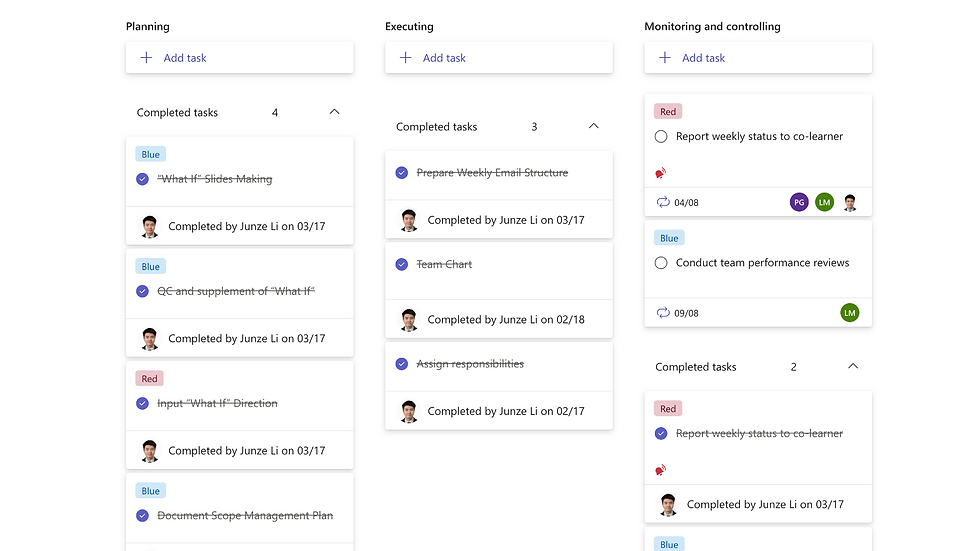
Project management board (Microsoft Teams Planner): illustrates task allocation, workflow structuring, and how responsibilities were distributed and tracked across different phases of the project. This reflects our decentralized leadership approach.
Slide drafts and design iterations: demonstrate the evolution of our project structure. This includes how ideas were synthesized, refined, and integrated into a coherent narrative under time constraints.
Internal communication (Teams and email exchanges): provide insight into team coordination, decision-making processes, and how roles and responsibilities were negotiated and clarified throughout the project.
Notes from discussions with the Municipality of Amsterdam and feedback from the professor: highlight how external input shaped our thinking, challenged our assumptions, and contributed to refining both our problem framing and proposed directions.


Dank je wel!